AI Search Analytics, Paired With an Engine That Does the Work
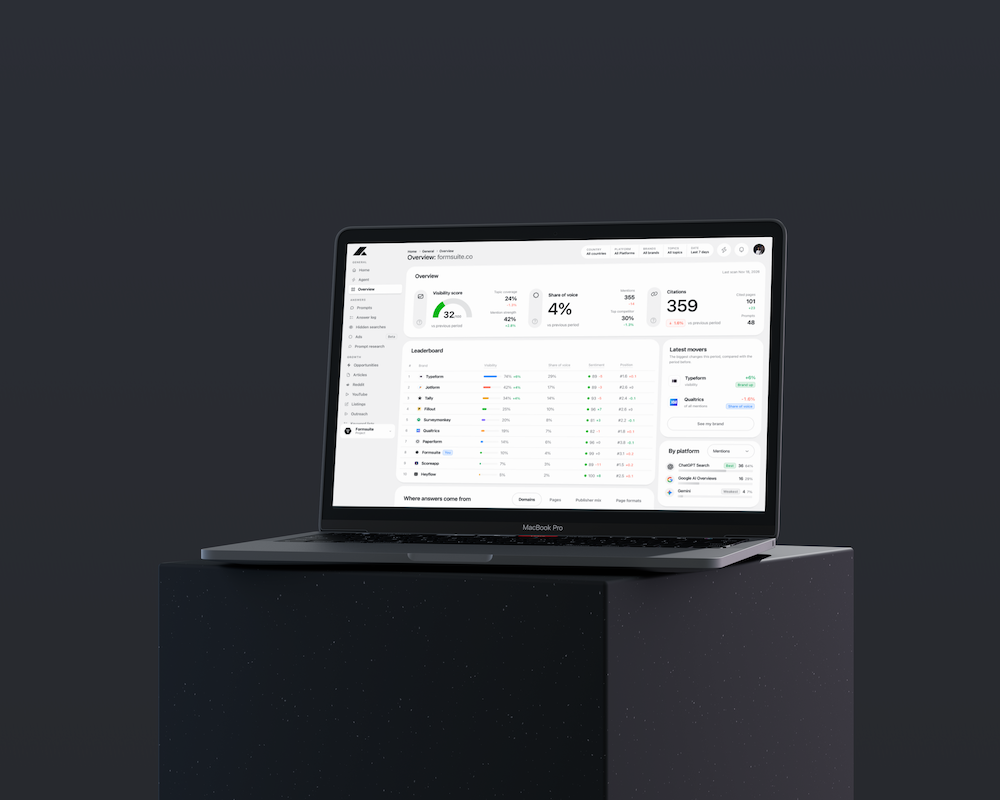
Recited AI shows brands how ChatGPT, Google AI Overviews, Gemini, Perplexity and Claude answer the questions their buyers ask, who gets recommended instead of them, and which sources decide it. Then it turns every gap into a scored, pre-drafted piece of work. I designed, built and launched the platform solo, from the daily multi-engine scanning pipeline to the AEO article editor and the marketing site around it.

Buyers increasingly ask an AI assistant which product to pick instead of scrolling through ten blue links, and an AI answer names two or three brands, not ten. Traditional SEO tools can't see that surface at all. I built Recited AI to measure it properly and, more importantly, to tell brands what to do about it. It's an answer engine optimization (AEO) platform: you add your brand, market and topics, and Recited suggests the questions buyers actually ask assistants, along with how often each one is asked.
The analytics side is built around one rule: every number opens into the raw answer that produced it. Each day Recited asks every tracked question across the major engines and keeps the full responses. Where an engine has a real consumer app, it reads the answer there with its own browsers rather than through an API shortcut that can return something different, so the wording, order, links and sponsored slots match what buyers see. On top of that sit the pieces most AI search tools miss: the searches an engine runs before it replies, every page it cites ranked by how much it costs you, ads appearing inside AI answers, results asked from the country a brand actually sells in, and competitors discovered automatically. The visibility score has a published formula, so anyone can recompute it by hand.
The part I care most about is what happens after the dashboard. Every gap lands on one board as a scored opportunity with a brief attached: the questions it answers, who is recommended instead, what the winning page does well, and an outline built from the searches the engines actually ran. Not every gap needs a blog post, so the growth engine picks the move that fits: an answer-first article for your own site, a helpful reply in a Reddit or forum thread assistants keep quoting, better copy for a G2 or Capterra listing, or a short pitch to the author of a roundup that ranks your rivals and leaves you out. The work is drafted from the evidence and waits for review; Recited never posts on a user's behalf.
The AEO article editor is a product in its own right: a clean, block-based editor that drafts from the answers buyers see, audits the page as you write for what makes it citable (the answer up front, question-led sections, a source behind each claim), takes plain-English instructions on any highlighted line, and scores drafts for human quality. Beyond the app, Recited offers MCP and AI agent access, data export, unlimited users on every plan, and a project-per-brand model that lets agencies run each client separately.
I built the full stack on Next.js, SCSS modules, tRPC, Prisma, PlanetScale and Inngest, with Stripe handling subscriptions and a free trial, Sentry for monitoring, and OpenAI powering the analysis and drafting, alongside a dedicated capture worker for the browser-based scanning. I also run Recited on my own products; it's become the main tool I use to grow Formsuite's visibility in AI search. It's the most technically demanding product I've shipped, and the one that best reflects how I like to work: measure honestly, show the working, and end at the action rather than the report.
FAQs about Branding
What problem is Recited AI solving?
More and more buying decisions start with a question to an AI assistant, and the answer only names a handful of brands. Recited measures that surface: which questions a brand appears in across ChatGPT, Google AI Overviews, Gemini, Perplexity and Claude, how it's described, who takes the slot when it isn't named, and which pages the engines read to get there. Unlike a pure dashboard, it then turns each gap into a specific piece of work.
Why read the real AI apps instead of calling their APIs?
Because the API and the app often return different things. The consumer apps run their own web searches, cite sources and now show sponsored placements, none of which reliably comes through an API call. Reading the real interface means the answers Recited records are the ones buyers actually see, including the background searches and any ads beside the brand. It's the harder engineering choice, but it's the only way every metric can open into a real answer.
How does the growth engine decide what to draft?
AI engines don't invent recommendations; they summarise pages. Recited ranks every source it sees the engines read and scores the ones sending competitors into answers the brand is missing from. Each gap is matched to the move that fits: an article, a community reply, directory listing copy or an outreach pitch. The draft is generated from the captured answers and competitor pages, so it starts from evidence instead of a blank page, and the next scan shows whether it worked.
What was the hardest part technically?
Making the scanning pipeline both trustworthy and affordable. Running hundreds of prompts across five engines every day, from multiple countries, through real browser sessions, then turning free-form answers into consistent brand, source, position and sentiment data, has a lot of moving parts that can fail quietly. Much of the work went into reliability, retries, deduplication, and making sure no metric drifts away from the answer it was computed from.
What did you take away from this project?
That a dashboard which only reports bad news is half a product. The most important design decision in Recited was refusing to stop at the metric: every finding has to become something a team can act on this week. It also sharpened how I think about honesty in analytics tools: show the working, publish the formula, and keep a person in the loop before anything goes out.
Tools of Choice





Let's talk!
hello@bradyedgar.com© 2025 Brady Edgar. All rights reserved.